The Bespoke Furniture Design Process in London: An Interpretive Architectural Journey
- Neil Norton Design

- Jun 20
- 12 min read
Updated: 7 hours ago
A truly singular home is never found in a showroom. It is authored through a meticulous dialogue between the existing architecture and the inhabitant's personal narrative. Many homeowners find themselves overwhelmed by generic, mass-produced options that fail to respect the unique proportions of a London residence. You've likely felt the concern that a new piece might clash with your home's established architectural language, or perhaps you're uncertain how to translate a creative vision into a technical reality.
The bespoke furniture design process London artisans utilise is not a mere manufacturing sequence; it's an interpretive journey. By engaging in a professional design consultation, you can discover how intentional materiality and refined detail transform functional items into works of art. This article explores how a commitment to architectural precision and material honesty creates a seamless transition from conceptual idea to a refined spatial work. We'll show you how to achieve a home that feels entirely authored, featuring furniture designed to last a lifetime whilst quietly elevating your daily experience through design sensitivity.
Table of Contents
Understanding the Bespoke Furniture Design Process in London
The bespoke furniture design process London residents encounter is often misunderstood as a simple selection of finishes. In reality, it represents a collaborative, interpretive journey where the goal is to quietly elevate daily use through profound design sensitivity. To gain a foundational understanding of bespoke design, one must look beyond the mere assembly of components. It's the creation of a singular spatial work that respects the existing architectural language of a home. Nothing is incidental; every choice is a deliberate step toward spatial harmony.
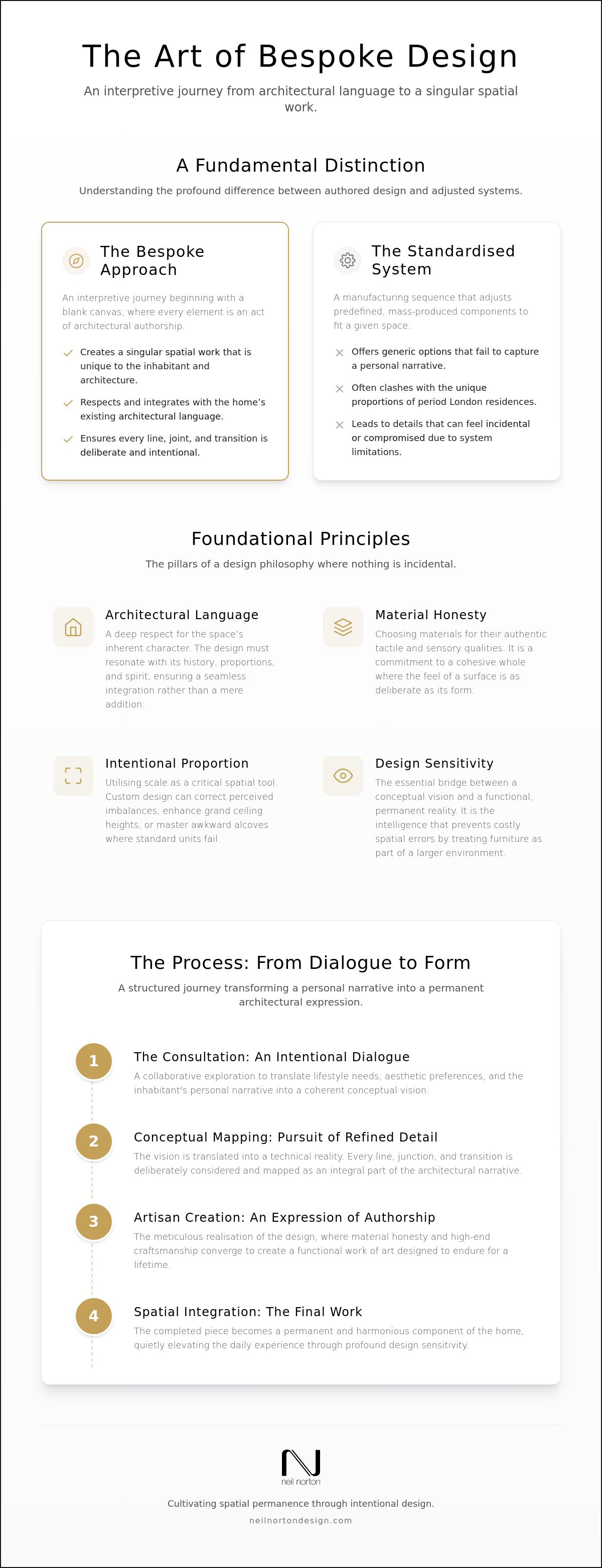
There's a significant distinction between 'custom-made' and truly 'bespoke' furniture. Custom-made often refers to standardised systems that are adjusted to fit a space. True bespoke design is an act of architectural authorship. It starts with a blank canvas. This distinction is vital in London, where the residential landscape is defined by period properties with unconventional proportions. These spaces demand a tailored approach that transcends the limitations of mass-market, system-based solutions. A design consultant acts as a catalyst here, translating lifestyle needs into a permanent architectural expression.
The Interpretive Nature of Modern Design
Modern design must move beyond predefined options to treat the entire room as a cohesive whole. Every line, joint, and transition must be deliberate. When designing for complex residential layouts, professional insights provide necessary creative direction that a standard catalogue cannot offer. We reject the incidental in favour of the intentional. This interpretive approach ensures that the pursuit of refined detail is maintained throughout the project, resulting in junctions that are an intentional part of the architectural narrative.
Why Design Sensitivity Matters
Design sensitivity is the bridge between a client's favourite aesthetic and a permanent, functional reality. It ensures that the materiality of a piece resonates with the tactile harmony of the room. The initial consultation phase of the bespoke furniture design process London experts provide is essential for preventing costly spatial errors. These errors often occur when furniture is treated as an isolated object rather than a component of a larger environment. By focusing on material honesty and proportion, the resulting work becomes an expression of authorship that enhances the home's value for a lifetime. It's about creating a space where the transition from conceptual vision to technical precision is seamless and enduring.
The Architectural Language: Materiality and Proportion in Custom Design
The success of the bespoke furniture design process London artisans employ relies on a deep respect for architectural language. It isn't enough for a piece to fit the physical dimensions of a room. It must resonate with the space's inherent materiality. This pursuit of refined detail begins with material honesty. When we choose a timber or a stone, we aren't just selecting a surface. We're choosing a primary component of a cohesive whole where nothing is incidental. Every line, joint, and transition is a deliberate choice made to enhance the intellectual and sensory experience of the home.
Materiality and Tactile Harmony
High-end craftsmanship is rooted in the sensory experience. The way a hand-finished oak surface feels under a palm or the silent, weighted close of a joint are not accidental details. They're the result of deliberate design sensitivity. Selecting timbers and finishes that speak to a home's heritage ensures the work transcends fleeting trends. In a Victorian or Georgian terrace, the choice of material should reflect the weight and history of the structure. This tactile harmony transforms functional cabinetry into an expression of authorship. Every junction becomes a point of interest where the transition is intentional and the quality is felt.
Proportion as a Spatial Tool
Proportion dictates how a room is perceived and lived in. In many London properties, the challenge lies in grand ceiling heights or awkward alcoves that mass-produced units simply cannot address. This is where fitted furniture becomes an essential spatial tool. By utilising verticality and respecting the existing scale, we can correct or enhance the perceived proportions of a room. A singular spatial work should feel as though it was always intended for its location. This balance is achieved through the rejection of predefined options. Instead, the focus remains on how the furniture interacts with the light and flow of the environment.
Classic design that lasts a lifetime is the ultimate goal of any serious commission. It requires a rejection of the superficial in favour of the permanent. By treating cabinetry and surfaces as architectural components rather than mere additions, we ensure the work remains relevant for decades. If you're ready to begin your own interpretive journey, you can explore our approach to bespoke design to see how these principles are applied in practice. The result is a home that feels authored and singular, where every element contributes to a sense of quiet, elevated living through refined detail.
Beyond Standardisation: Why Bespoke Design Transcends Mass-Market Options
The bespoke furniture design process London homeowners seek is often a reaction against the limitations of predefined systems. Standardised furniture operates on a logic of manufacturing convenience, where the space is forced to accommodate the object. A singular spatial work reverses this hierarchy. It starts with the room's existing architectural language. By rejecting system-based furniture, we allow for a transition that feels deliberate rather than forced. This isn't merely about adding storage; it's about the creation of a permanent environment where nothing is incidental. The goal is to ensure your home feels authored and unique, resisting the pull of mass-produced aesthetics.
The Pitfalls of Predefined Systems
Off-the-shelf solutions, even those marketed as luxury, fail to integrate with the complex nuances of London's domestic architecture. Period properties rarely feature perfectly plumb walls or standard ceiling heights. When a predefined system is inserted into such a space, the result is a visual compromise. Gaps are often filled with crude strips of timber, and junctions lack tactile harmony. There's a profound lack of authorship in these mass-produced items. They don't reflect the inhabitant's personal history; they reflect a manufacturer's assembly line. Whilst these systems might offer a temporary fix, they rarely provide the spatial permanence required for a forever home.
The limitations of standardisation are particularly evident when considering the bedroom. Navigating the specific constraints of fitted wardrobes london requires more than just a list of measurements. It demands an interpretive design journey. We must consider how the verticality of a wardrobe interacts with original cornicing or how the depth of a unit impacts the spatial flow of a room. A professional consultation ensures these technical realities are addressed with precision, turning a potential spatial error into a refined detail that enhances the room's proportions.
Bespoke as an Expression of Authorship
Choosing bespoke design is an investment in permanent value. It transcends function to become an expression of authorship. Every element is intentional. We create environments that reflect the sensory and intellectual needs of the household. There's a quiet confidence that comes from owning a singular, award-winning design. It isn't a fleeting trend; it's a classic work that lasts a lifetime. Amongst the clutter of modern consumerism, a bespoke piece stands as a testament to material honesty and craftsmanship.
Working with a seasoned expert provides a sense of psychological security. We've successfully navigated the complexities of high-end domestic architecture for over 200 happy clients. This experience allows us to act as a trusted advisor, ensuring the transition from conceptual vision to technical precision is seamless. The result is a home that feels authored and permanent, where daily use is quietly elevated through design sensitivity and a rejection of the predefined.
Navigating the Design Consultation: From Conceptual Vision to Technical Precision
The bespoke furniture design process London homeowners experience is a journey of translation. It begins with an initial dialogue that uncovers the interpretive needs of the household. We don't start with a catalogue; we start with the soul of the space. This conversation allows us to understand how you inhabit your home and what sensory experiences you value most. It's about moving beyond the functional to find the intellectual heart of the project.
This interpretive journey moves through five distinct phases to ensure the final result is a singular spatial work. Following the initial dialogue, conceptual mapping defines the architectural language and spatial flow. This phase is critical in London's residential landscape, where period features and unconventional layouts demand high-level expertise. We then move to material selection, achieving tactile harmony through a curated palette of timbers and finishes. Technical refinement follows, ensuring that every line, joint, and transition is deliberate. The final vision results in a cohesive plan for bespoke kitchen design or sophisticated storage that feels entirely authored.
Translating Visions into Architectural Plans
Site surveys are indispensable when working with London's unique spatial nuances. We've seen hundreds of projects where a millimetre's difference in an alcove dictates the success of a piece. Professional sketches and architectural plans bridge the gap between a conceptual idea and a technical reality. This isn't just about drawing furniture. It's about refining the design until daily use is quietly elevated. We iterate on these plans to ensure the final work respects the home's heritage whilst providing modern utility. The goal is to create a seamless transition from the imagination to the physical environment.
The Role of Technical Precision
Refined detail is never a happy accident. It's the result of rigorous planning that takes place long before manufacture begins. Technical precision allows us to integrate modern technology and complex storage solutions seamlessly into the cabinetry. Nothing is incidental. Whether it's the hidden cable management in an AV cabinet or the internal lighting of a wardrobe, every component is part of a singular spatial work. This pursuit of precision is what allows a piece to transcend its function and become an expression of art. Every junction is a testament to the pursuit of refined detail and material honesty.
If you're ready to transform your residential environment, you can book a professional design consultation with our Wimbledon-based team. We'll guide you through each stage of this interpretive journey, ensuring your vision is translated with architectural precision and a commitment to enduring quality.
Cultivating Spatial Permanence with Neil Norton Design
The bespoke furniture design process London homeowners choose with us is an invitation to create something truly permanent. We believe that furniture should not be a transient addition but a foundational element of the home's architecture. Our philosophy is centred on the creation of classic design that lasts a lifetime, ensuring that every piece remains as relevant in twenty years as it is today. By treating functional objects as works of art, we help you cultivate a sense of pride and security in your living environment. This approach ensures that daily use is quietly elevated through a commitment to material honesty and design sensitivity.
Our dual presence in both London and Ireland allows us to offer a distinct perspective that few others can match. This geographic pairing combines the technical precision of high-end manufacturing with an artistic vision that is deeply rooted in heritage. Whilst our Wimbledon studio provides localised prestige and accessibility for our London clientele, our broader operational scale ensures we can handle the most complex residential commissions with quiet confidence. This regional identity informs our work, blending the practical needs of urban living with a timeless aesthetic that transcends fleeting trends.
A Legacy of Craftsmanship
We are proud to celebrate 20 years of bespoke design excellence. During this time, we have successfully transformed over 200 residential projects, each one a unique expression of authorship. This extensive portfolio serves as more than just social proof; it is a testament to our reliability and the enduring quality of our work. Our award-winning status provides immediate trust, allowing clients to feel secure in the knowledge that they are working with a seasoned expert who understands the nuances of high-end domestic architecture. Every joint, line, and transition we create is a result of two decades spent perfecting the pursuit of refined detail.
Commencing Your Design Journey
The first step toward spatial permanence begins with a professional design advisory session at our Wimbledon showroom. This session is not a standard sales meeting but a dedicated consulting experience where we uncover the interpretive needs of your household. We discuss the architectural language of your home and how our bespoke kitchens, home offices, or wardrobes can enhance your daily life. We focus on how materiality and proportion can be used to create a singular spatial work that feels authored and intentional. You can enquire about your professional design consultation today to begin the journey of transforming your residence through a process that values precision, durability, and artistic vision.
Transform Your Home Through Architectural Authorship
Transforming a residence into a singular spatial work requires a rejection of the predefined. By embracing material honesty and architectural precision, you ensure that every line and junction in your home is deliberate. The bespoke furniture design process London artisans at our studio provide is an interpretive journey that transcends simple function to create a lasting expression of authorship. You've seen how intentional materiality and refined detail can quietly elevate daily life whilst respecting the unique heritage of your property.
With over 20 years of architectural design expertise and a portfolio of 200+ happy clients across London and Ireland, we're dedicated to creating classic design that lasts a lifetime. Our award-winning bespoke design studio blends technical precision with an artistic vision to ensure your vision becomes a permanent reality. Every project we undertake is a commitment to quality and tactile harmony.
Book your professional interior design consultation with Neil Norton to begin authoring your home's next chapter. We look forward to helping you create a space that feels entirely yours.
Frequently Asked Questions
What is the primary difference between bespoke and fitted furniture?
Truly bespoke furniture is a singular spatial work created from a blank canvas, whereas fitted furniture often relies on standardised systems adapted to a room. Bespoke design allows for total control over materiality and proportion, ensuring every line and joint is intentional. This distinction is vital for those seeking an expression of authorship rather than the application of a predefined system.
How long does the bespoke furniture design process typically take in London?
The bespoke furniture design process London clients undergo typically spans twelve to sixteen weeks from the initial conceptual mapping to final installation. This timeline allows for the pursuit of refined detail and the careful selection of timbers. Each stage, including technical refinement and hand-finishing, is deliberate to ensure the work lasts a lifetime. Complex residential projects may require additional time to achieve perfect tactile harmony.
Do I need to have a clear vision before my first design consultation?
You don't need a fully formed plan before your first advisory session. Our role is to act as an interpretive catalyst, uncovering the needs of your household through dialogue. We translate your favourite aesthetics and sensory preferences into a cohesive architectural language. Professional insights help bridge the gap between a vague conceptual idea and a refined technical reality, ensuring nothing is incidental in the final work.
Can bespoke furniture design integrate with period features in London homes?
Bespoke design is specifically engineered to respect and enhance the architectural language of period properties. Whether navigating original cornicing or unconventional alcoves, a tailored approach ensures a seamless transition between the new cabinetry and the existing structure. By utilising material honesty and precise scale, the furniture becomes a component of the room's history. This integration prevents the visual compromise often seen with mass-produced options.
What materials are most suitable for high-end bespoke cabinetry?
High-end cabinetry thrives on material honesty, favouring sustainable hardwoods like oak or walnut and premium veneers. These materials offer the durability required for furniture intended to last a lifetime. Tactile harmony is further achieved through the careful pairing of timbers with natural stone or refined metals. The selection process focuses on how these surfaces interact with light and the sensory experience of the inhabitant within the space.
How does a professional consultation help with budgeting for a renovation?
A professional consultation provides a clear roadmap that helps define the scope and prevent costly spatial errors. By addressing technical precision during the conceptual phase, we ensure that the investment reflects the permanent value added to the property. This structured approach allows for a logical transition from the visionary to the practical, ensuring that every joint and transition is planned within the agreed parameters of the project.
Is bespoke furniture design a worthwhile investment for a London property?
Investing in the bespoke furniture design process London residents trust is a commitment to spatial permanence that significantly enhances the authored feel of a property. Beyond the immediate lifestyle improvement, custom-made work created through rigorous design sensitivity acts as a permanent architectural asset. It transcends fleeting trends, offering a classic aesthetic that remains relevant. Discerning buyers often value the precision and craftsmanship of unique, well-integrated cabinetry over generic alternatives.
What should I prepare for my initial design consultation with Neil Norton Design?
To prepare for your initial advisory session, it's helpful to consider how you intend to use the space daily. Gather examples of textures or materials that resonate with your sense of tactile harmony. Whilst not essential, having basic room dimensions or architectural floor plans can assist in the conceptual mapping phase. This preparation allows our Wimbledon-based team to provide more specific creative direction during your first interpretive dialogue.


Comments